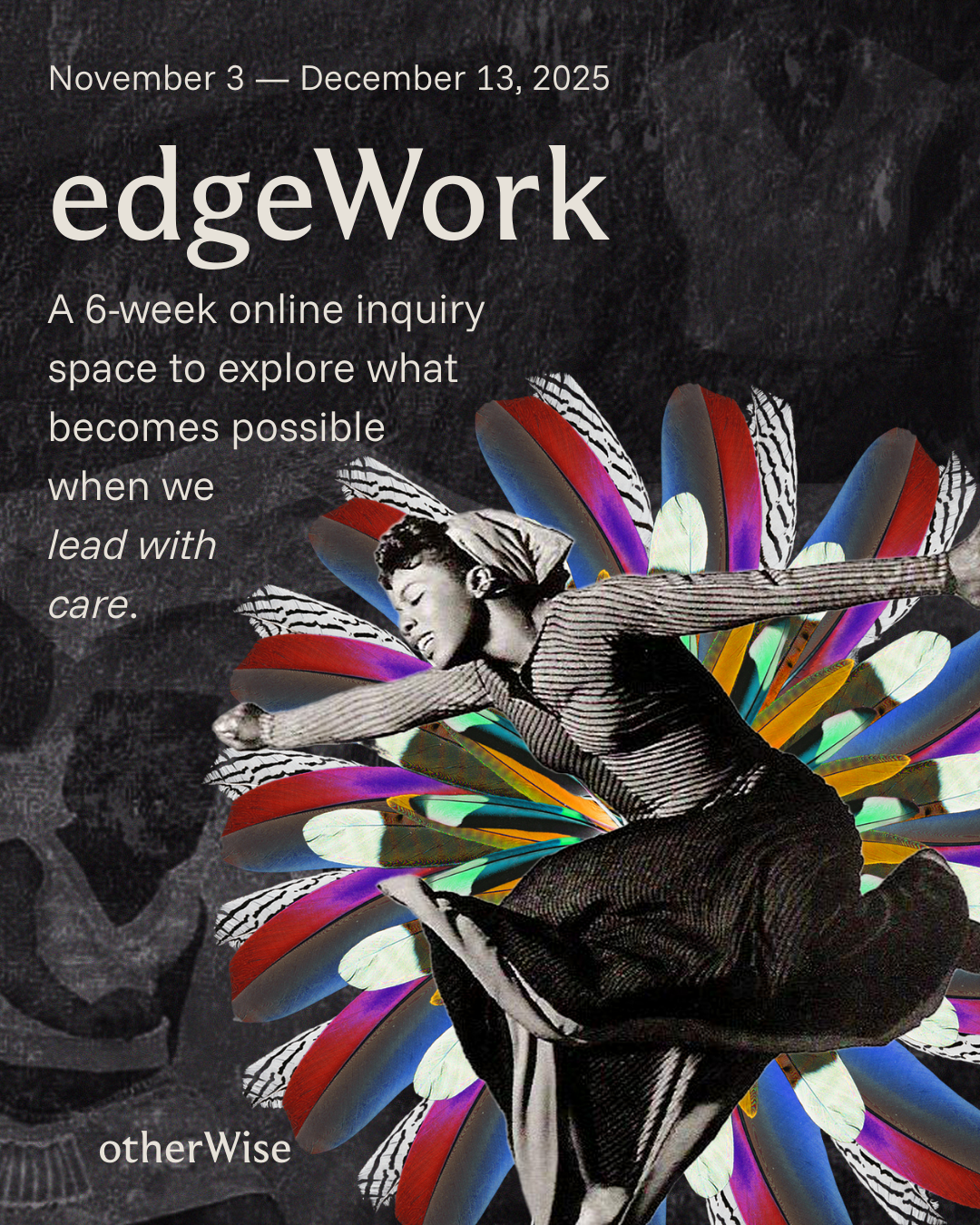

Within this blog, Nakasi, the host of the edgeWork learning journey, reflects on the invisibility of care in our lives. It is noticed only when the absence of care emerges. By sharing her family’s intimate moments, Nakasi questions care not only as a personal virtue, but as a political, relational, and ecological aspect of life. Here, individual resilience is transcended by shifting toward collective care-fullness.
Contributor bio
Nakasi is a multi-situated edgeworker who is living, learning and loving across communities, disciplines and countries. She coordinates the day-to-day movements of otherWise, grounding our operations in care and coherence. Nakasi co-leads our Edgework learning arc, bridges across programs and platforms, and holds space for hard conversations with warmth, clarity, and integrity.
As I am writing this, I am sitting in a little nook in a cozy corner of a tiny house in the Northeast Kingdom of Vermont. At the side of me are about seven colorful pillows mostly shades of blues and mustard yellow. To the back of me is a sash window with the sun staring in. This is more than a peak. More yellow. Right infront of me, and quite possibly the best part of this scene, is my family. They are playing a game of Laugh and You’re Out and all I see is bad acting, all I hear is their laughter and the bark of the dogs who are triggered by the acting. But these sounds, this sight, it is indeed the most beautiful life.
It’s in this seemingly ordinary, messy, joyful moment that I’m reminded why we start with care.
This moment didn’t just happen. I mean it did. The laughter was spontaneous. But there was a lot of care full preparation that needed to go into it – to give us this moment of togetherness and to give me the inspiration for this piece of writing.
There’s more to this scene than comfy pillows and canine applause. My husband and I have been quietly shepherding this moment into being by choosing to isolate for a week before our visit. It’s our twice-yearly routine. Summer and Winter. We stay at home, we test for SARS-CoV-2 before we leave, and we test for SARS-CoV-2 when we arrive. We do the work to keep our loved ones safe. We do small things (that some consider strangely big things) because the people in this room include immunocompromised family members. Without safety, this joy would be brittle, could be catastrophic.
Care is often like that, though. It’s invisible until it’s absent. It’s easy to notice when no one thought of bringing water on a long hike, or when no one remembered to ask about food allergies before planning the dinner. But when care is present, it often looks like ease. It looks like laughter and dogs barking at bad acting. It looks like this scene with my family.
This is why I return again and again to care as the starting point. It is the groundwork and the soil from which everything else grows.

“Think of the difference between a garden planted with attention to pollinators and soil health, and a field stripped bare by extraction. One is animated by care, alive with bees and blossoms. The other shows care’s absence through depletion, silence, and hunger.”
Care Beyond the Personal
It would be so easy to read this as a personal story – and it is. But what I’m after here is something larger, something more expansive: a reframing of care as political, relational, ecological.
We live in a time when individual resilience is celebrated. Everywhere you look, people are commended for being resilient as if it were a badge of honor. But resilience without care breaks people. Resilience, by itself, is so incredibly problematic because it places upon individuals a responsibility for pushing through whatever the system gives them.
What happens if, instead of individual resilience, we start with care?
This shifts the question from “How do I survive this?” to “How do we tend to one another so that survival is shared and flourishing is possible?”
Think back to the pandemic years (which, if we’re honest, are not behind us). Neighbors leaving groceries on doorsteps. Strangers masking to protect the vulnerable. Families isolating to make visits safe. These were not simply stand-alone acts of kindness. We were engaging in creative, relational practices of care that rippled outward.
Care beyond the personal asks: What is affected by what I do or do not do? How can my choices contribute to the well being of communities I am entangled with?

Care as Ecological
And you know, care doesn’t stop with us. It extends to the more-than-human world. It extends to soil, seeds, river, forests, and all the other pieces of the natural world that teach us about interdependence. In the same way that laughter with my family depends on small, quiet acts of tending, so does our collective survival as a species depend on how we tend to the earth.
Think of the difference between a garden planted with attention to pollinators and soil health, and a field stripped bare by extraction. One is animated by care, alive with bees and blossoms. The other shows care’s absence through depletion, silence, and hunger.
Care in ecological terms means asking: What does the land need to flourish? What would it mean to live as if our survival were entangled with our more-than-human kin?
Because it is. Whether we know it or not, it is.
As Vanessa Andreotti and the work of the Gesturing Towards Decolonial Futures teach us, to re-learn care ecologically is to refuse the illusion that humans are apart from the living fabric and reweave ourselves back into cycles of reciprocity.

Returning to Where I Began
As I write this, the game of Laugh and You’re Out has been paused – interrupted by a video call from Burkina Faso. My husband is outside speaking to his brother in their native tongue – Lobiri and some French mixed in about the black-eyed peas that he (my husband) is having his brother cultivate in their village. The dogs have quieted, for now. Everyone else is awaiting the resumption of the game.
And I am sitting here, typing this, grateful. Grateful for the care that made this moment possible. Grateful for the messy, ordinary beauty of family. Grateful for the reminder that care, more than anything else, is where we must begin.
So let me end where I began: What happens when we start with care?
Perhaps this. Laughter spilling into the afternoon sun, safety held quietly in the background, life choosing joy. If that possibility calls to you, join us for a small circle where we’ll practice beginning there together.
If you’d like to practice starting with care by experimenting in community and hold hard questions together, we’ll begin on November 3rd, 2025 and end on December 13th, 2025. Our live circles are scheduled for Saturdays at 11 AM – 12:30 PM ET.
If this feels like the right season, join the inquiry. We’ve got 30 seats available.