
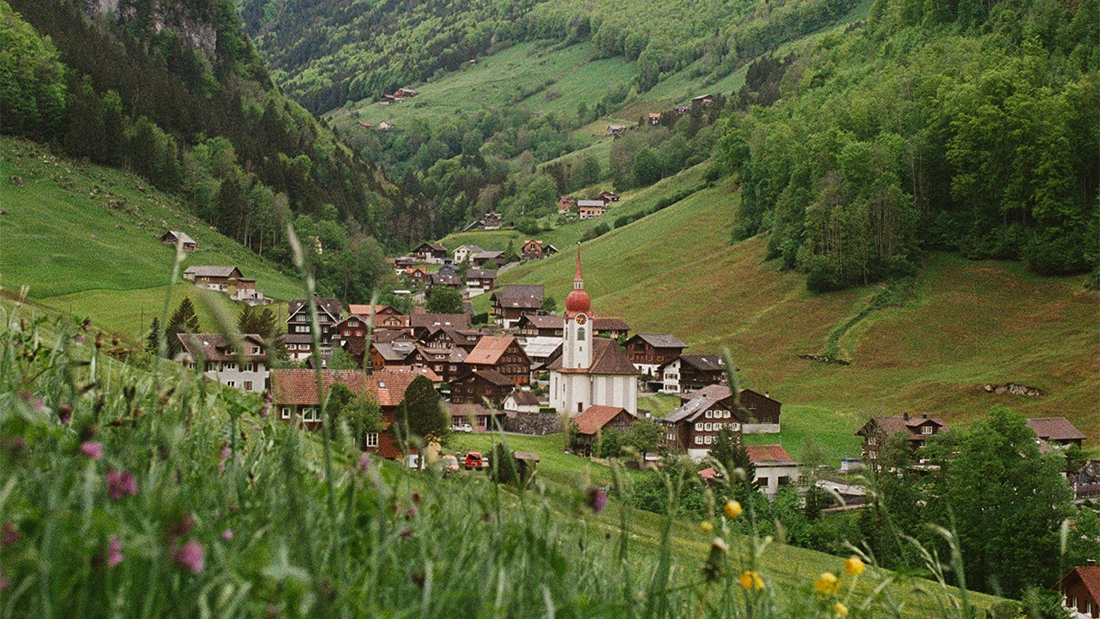
A village is how we humans and non-humans live together. The scope and range of a group of people is determined by the availability of energetic input. In revillaging, we consider the essential needs of our communities and lost skills needed to meet them with a grounded, realistic view of our entanglement with the Earth and in the midst of a wounded planet, and fractured culture.
Join our upcoming reVillaging cycle December 2025 – January 2026 for three online circles.
I sense my ancestors in my aching. Ancient ones with names I cannot know. Ancestors who lived my longings.
They lived in ways and worlds that haven’t been, cannot be, depicted in movies made when moderns attempt to imagine distant pasts. Lives of love and struggle. Making and mystery. Connection and limitation. Their feet knew the riverbed the way my wrists know a steering wheel, the way my fingertips move over this keyboard. They read the clouds and the air (its thinness, thickness, or movement), the way I read tone in a text message. They gathered around a fire the way my family gathers around a television.
Though long dead, they remain present and protect a pattern that could still show us a way to live through an end of endings. And sometimes, when I notice that I need a kind help I don’t know how to ask for, they move near.
I feel them when I’m bereft. When I once again look at real estate listings elsewhere, hoping for home, they wince. When I swallow the shame of not knowing our neighbors’ names, they sigh. They’ve been sighing for so long, but still not letting go. Perhaps they, too, have to be where they are. Which may mean to be where I am, where all their descendants are.
Their presence – neither question nor answer, neither admonition nor encouragement – encourages me to keep trying to find the unimaginable possible. To rearrange. To move nearer.
Making Home, Together Again
Village life feels like a fantasy. But it is memory. Hazy and partial, but once real. A longing for context passed down through blood and bone, through stories whispered across generations, sometimes named and sometimes unnamed. It may ache in our bodies before it forms in our minds. And when it does find language, it often comes in the form of a question:
– Where are the people I can rely upon as everything frays? The ones who need me, too.
– How can I be the river and not be able the reach the river?
– What will happen when we must once again live by sunlight, firelight, and mitochondrial heat?
The honest answer: Most of us don’t know. We haven’t been shown. We have little lived (and almost no sustained) experience of this. We’ve only known cultures that reward autonomy, mobility, and control. We move awkwardly, guarded, and yet impossibly fast through enclosed landscapes, navigating our local hills and valleys by global positioning system, making sure we are authorized to be where we are.
Our lives, subsidized by barrels of oil and made tolerable by microliters of dopamine, are energized by concentrated and fossilized sunlight, not by the diffuse light and heat that departed the sun eight minutes earlier or is stored in plants that recently soaked up some of those rays.
We’ve been socialized in societies that centralize competition, thin cooperation into transaction, and treat need as weakness. And so we scroll for answers, beg with landlords or mortgage brokers for a house that we’ll try to turn into home, and pine for a community that surely must exist somewhere else. We tend to romanticize both the city and the countryside – letting our minds focus on the opposing wonders of each, pushing their considerable downsides off the edges of our daydreams. We ridicule suburbs, with their subdivisions and homeowners associations – tortured substitutes for something we surely once knew. We might even research intentional communities to ease the pain of enduring all this unintentional but defended disconnection.
The internet (or at least the corners of it that get presented to me) is increasingly full of laments for the village observations about the mismatch between our longings and our actions, and musings about why we struggle to make the Village manifest – sometimes despite our showing up for it again and again.
So many of us say we want a village; know we need a village.
But do we actually want to be villagers? Do enough of us want it enough to try? And if so, how do we find folks around us who are also willing to hazard their hope and help on each other? Where might we start?
reVillaging is the effort to live these questions. Not by returning to a fixed, specific, or nostalgic past, but by practicing relational arrangements that make shared survival and sufficiency possible again. The urge to reVillage will be regarded by some as a romantic retreat, but those who are serious about it must approach the effort as a necessary (non-optional) reorganization. But how do we start? Not with a strategic plan. Instead, reVillaging might be approached as a series of rehearsals – all improvisational and intergenerational – for post-imperial life in the ruins of separability.
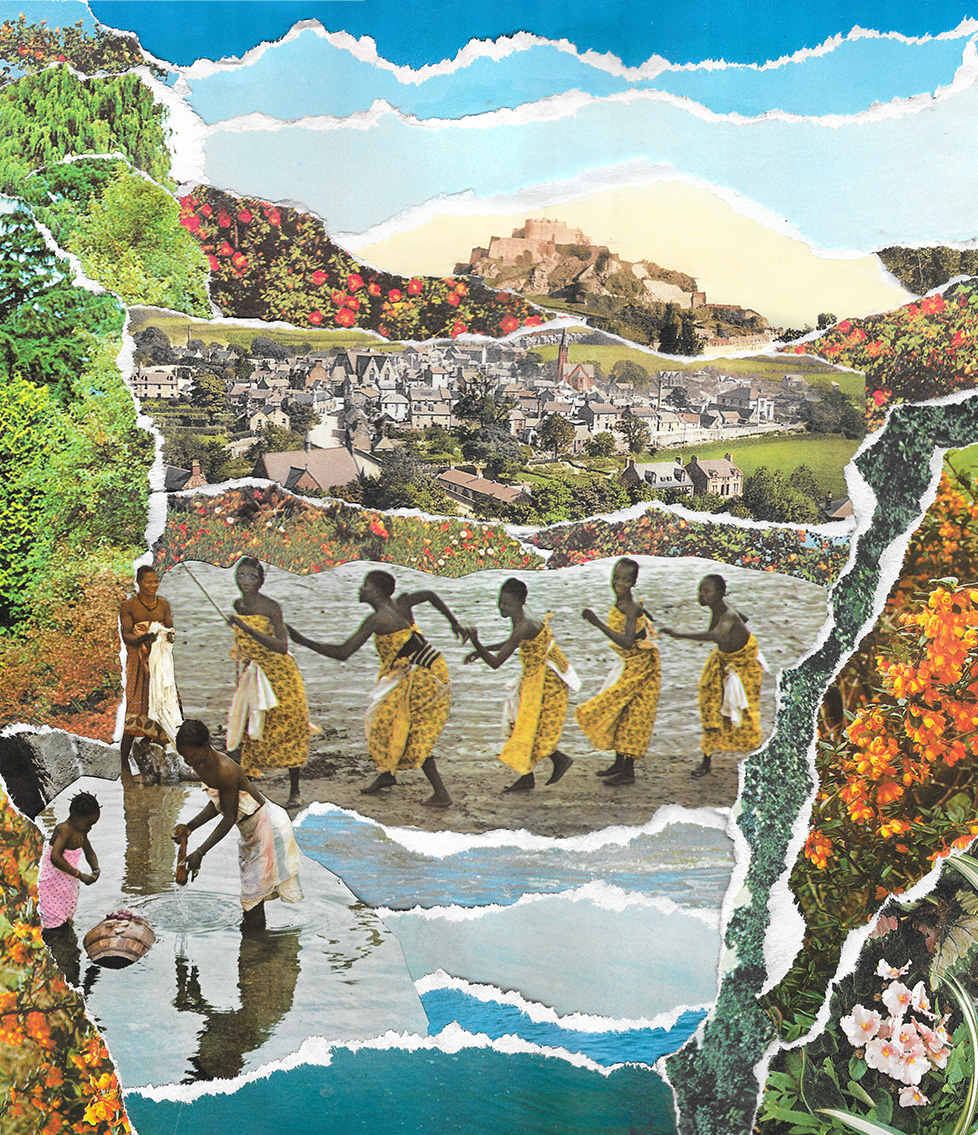
“revillaging”, original collage by Sympoiesis for otherWise
“We’ve been socialized in societies that centralize competition, thin cooperation into transaction, and treat need as weakness. And so we scroll for answers, beg with landlords or mortgage brokers for a house that we’ll try to turn into home, and pine for a community that surely must exist somewhere else.”
Arrangements that Aren’t (re)Villaging
Negation is not an especially generous way to introduce a concept. And yet, because so many of us have felt the longing for the lost village, chances are that readers have already gotten excited about (or even tried) one or more alternatives to now-normative arrangements that fall a little – or a lot – short. So before we feel into what reVillaging might be, it seems helpful to touch on some of the things that it is not – especially because each of the attempts below gets some of the facts and feelings right, but stops short of honoring interdependence and or recognizing that we exist within and because of relations.
Villaging is not homesteading. It is not merely individual or familial resilience (though it can offer those benefits, too). It is not rugged self-sufficiency wrapped in aesthetics of natural living. Homesteading, for all its throwback charm, too often reproduces settler logics and expansionary pioneer claims – ownership, autonomy, inheritance, purity, protection. It puts the family at the center of land use and access, often to the exclusion of others and without regard for the peoples and beings that once called that place home.
It is also not just clusters of privately-held family farms or small businesses operating and competing primarily within the market economy. While they can be locally-rooted and even interdependent in some ways, these models still replicate the very dynamics we are trying to transform – privatized land tenure, market dependency, and scarcity-driven competition dressed up as sustainability. Family farming, at least as it has been structured and idealized in the United States, has proven itself to be a fairly terrible way to organize agriculture, though a highly effective way to hold stolen land and promote urbanization.
Nor is it some kind of trad-wife resurgence, idealizing subservient homemaking, perfected decor, or performative hosting – a plasticized version of hospitality as we’ve known it under capitalism and patriarchy. Villaging is not the privatized labor of women making beauty and care inside isolated domestic units while their husbands continue earning income in extractive enterprises, and the world churns or burns around them.
It is also not sustainable urbanism, though it may share some goals and can actually happen within cities. Where sustainable urbanism seeks to retrofit the city within existing governance and economic systems, reVillaging grows beneath and beyond them. It doesn’t start with design standards, emissions targets, or offsets elsewhere. It starts with relationships, with skill-sharing, food swaps, rain barrels, co-parenting arrangements, and seasonal rhythms. It measures success not in kilowatt reductions but in shared compost piles, in mended clothes, in the number of neighbors who know how to save seeds and cook for a crowd – and in how much time folks have to do so. And yet, it bears noting that reVillaging is not necessarily or exclusively a rural pursuit. As we will see in Part 2, reVillaging does require direct access to and unmediated, conscious relations with land. But it is a mistake to imagine that there isn’t land beneath and between the concrete and steel of modern cities. Both the spirit and the practices of reVillaging adapt to edge spaces, city gardens, abandoned lots, and neighborhood networks.
“It starts with relationships, with skill-sharing, food swaps, rain barrels, co-parenting arrangements, and seasonal rhythms. It measures success not in kilowatt reductions but in shared compost piles, in mended clothes, in the number of neighbors who know how to save seeds and cook for a crowd – and in how much time folks have to do so.”
Intentional Communities: Close, but Not Quite
Intentional community? Closer, perhaps. But reVillaging doesn’t require – and probably won’t happen if the predicates are – a strict shared ideology, a mission statement, a retreat from the world, or even a purchase agreement. An intentional community is often expected to spring from the words we agree to; a village forms from shared life-making in place and reverence for relationships. (Note that this is not meant to be a study in strict opposites. Some “intentional” communities function more or less like villages, others more or less like cults, and still others more or less like dreams that turn into nightmares. Some intentional communities might even be subsets of villages.)
When a group decides to form an intentional community, the first act is often to draft a charter: a document that lists values, outlines governance, and paints a picture of the future. The charter becomes the centerpiece of meetings, the reference point for votes, the banner under which fundraising is pursued. It is a story that must first take root before any practice can sprout. The language is often precise, the structure administrative and process-oriented: a board or leaders are elected, bylaws are ratified, committees are appointed. Decision‑making concentrates in a small circle, and the health of the whole hinges on the health of that circle. If the board stalls, the budget freezes; if the committee dissolves, the garden goes untended. This kind of community resembles a single‑stem plant – strong in one direction, vulnerable if that stem snaps. Alternatively, decision-making requires consensus, and achieving complete agreement takes up a ton of time. This kind of community becomes a thicket that’s difficult to move within and crowds out diversity.
Among reVillagers (who might not even know to call themselves that), the opening move is different. The first question is not “What mission shall we proclaim?” but something like: Who knows how to build a greenhouse? To catch rainwater? To inoculate a mushroom log? To stitch a wound? To support a teen with anxiety? A new mother with mastitis? To preserve the harvest? To rig up power and radio communications to keep us connected?” In each case, the answer requires skill and care – immediate engagement of the hands, the senses, the body.
This contrast doesn’t mean that the village is held together purely by the practical and the material. It’s also the product of deep desire. It is energized by both longing (often expressed in exasperation: this isn’t it), and cheerful submission to our unavoidable need for each other.
reVillaging is kindled on questions:
– What if making home wasn’t a private act, but a shared one?
– What if oikos – the ancient root of both ecology and economy – could be reclaimed not as a site of consumption, but of care, co-creation, and collective aliveness?
– What if we could remember enough to make something different?
And it is stoked by the shared willingness to try. Thus, we might think of reVillaging as unintentional but tended community.

Community Cut Off: a story of stalled intentions and fractured faith
The vision was compelling. A group of friends, disillusioned with corporate life and hungry for community, pooled their resources to purchase a few acres just outside a quiet town. They gathered around kitchen tables and in long, excited Zoom calls, drafting a mission and vision that shimmered with hopeful words: regenerative living, shared governance, co-housing. Diagrams were drawn, land informally parceled out, working groups formed. A Slack channel was created for each subcommittee.
For a time, the energy was electric. Conversations flowed about co-housing models and consensus processes. Someone designed a logo. Someone else set up a fundraising page. Another enrolled in a permaculture course and began learning CAD software so he could draw up a landscape design. They created a Google Drive folder titled “Shared Dream.” But on the land itself, little had begun.
One family moved in and built some raised beds, but they were bright with dandelions and strangled in bindweed before anything was harvestable. Another discouraged gardening, saying the crops would just be eaten by the deer and the neighbor’s goats, who kept getting in through a hole in the fence. (Whose job was it to fix that?) And unprecedented July rains came heavy and fast, water pooled against the house, seeping into the old foundation.
A meeting was called. While everyone remained civil and solutions-oriented, the tension was palpable. As concerns about the water damage were raised, someone claimed it wasn’t everyone’s responsibility – it should be a facilities committee task. But the committee hadn’t met in weeks. Someone else obliquely blamed the family in residence for not digging trenches to redirect the water. Attempting to diffuse that conflict and suggested bringing in a contractor. But this violated the group’s principle of self-sufficiency. During the long meeting someone repeatedly corrected the language another person used to describe the storm, asking for more inclusive metaphors. Another spoke of “re-centering the land’s voice” but didn’t want to speak to the neighbor whose goats kept escaping through the shared fence and couldn’t imagine asking those neighbors for help. The conversation spiraled. Nothing was resolved.
By winter, fractures had widened. Some members started talking about the project in the past tense. One family left, citing health reasons. Another withdrew, citing micro-aggressions and emotional labor fatigue. A third said her new partner wasn’t ready to settle down in the middle of nowhere. In her final meeting, she insisted on getting her money back so she could invest in a cloud-seeding start-up her best friend was founding. The rest drifted into silence. The newsletter stopped and more requests for buy outs rolled in. They had built a beautiful map. But no one had started walking the road.
“Another spoke of “re-centering the land’s voice” but didn’t want to speak to the neighbor whose goats kept escaping through the shared fence and couldn’t imagine asking those neighbors for help. The conversation spiraled. Nothing was resolved.”
How a Village Begins: a story in cascading skills and shared longing
A young widower with two surly teenagers stood at the edge of his corner lot, staring up at the busted gutter as storm clouds gathered to the south.
“That’s not gonna hold up with what’s coming,” warned the decades-older woman across the street. “Wish I could help, but I can’t get up on a ladder anymore.”
“I wouldn’t know what to do even if I had a ladder,” he replied.
“Thought you were an engineer?” she asked, quizzically.
“Software engineer,” the 15-year-old chimed in.
“Well, if you can get the ladder out of my garage, I can talk him through it,” she said, nodding at the teen holding a crowbar and a screwdriver. “You’re going to need some different tools. I’ll check if Jimmy has any scraps left over from his renovation.”
That’s how it started. A few neighbors cooperating to repair a gutter before the storm. Jimmy came over with his kids, some leftover PVC pipe, a few cookies, and jokes. Miss Dolores remembered there was an old barrel in her yard they could use to catch water, which would help slow the flow. Kids rolled the barrel across the street while the adults fumbled with brackets and tested spigots. A few hours later, a barrel stood beneath the downspout, catching the first fat drops as clouds rolled in.
The rain came heavy that week and the power was out more than it was on, but the gutters held. The barrel filled – and then some, which was useful when the water wasn’t running. But two weeks later, when the barrel looked to be full of mosquito larvae, someone suggested hooking it up to a garden bed. A few others offered to dig a small channel. Dolores said she’d love to grow herbs but couldn’t manage bending down, so someone found cinder blocks to raise the planters. The patch grew. And with it, a rhythm. People showed up on weekends to weed and harvest. The garden needed more water, so a second barrel was added. Then a third. Someone offered to test the soil. Someone else taught the kids how to save seeds from the sweetest tomatoes.
Before long, they were talking about building a proper cistern, one that could serve multiple homes. The conversation wasn’t a formal meeting. It unfolded while snapping green beans, while watching kids dig in the mulch pile, while pouring tea on a porch. The idea didn’t grow from a mission statement but from a pattern of noticing and doing and noticing again: what we have, what we need, what we might try.
Somewhere along the way, rhythm gave way to reverence. Not quite ritual, but almost. The garden on the corner became a place where grief was shared, where prayers slipped into conversation without anyone calling them that. Some spoke of dreams they couldn’t shake – dreams of a life like this, but without the commute and with more shared. A few people began marking the solstices and equinoxes with candles and singing or silence, depending on who organized the observance. The practical and the mystical mingled like rain and soil. A place was starting to become a village. Not because someone declared it so, but because the acts of tending, improvising, witnessing, and showing up had made it real.
“Many of our earnest attempts at community falter not for lack of desire but because of the orientations we’ve inherited – stories, structures, and habits that have shaped our sense of what is normal, desirable, or even possible.”
What Obscures the Village?
The village described is an emergent property that forms as place-based care, shared effort and labor, and the metabolic rhythms of land are tended together. This lattice forms within the growing garden when the conditions and relations are right. Much like the organic intermingling of a Three Sisters planting, it is not built or engineered. Many of our earnest attempts at community falter not for lack of desire but because of the orientations we’ve inherited – stories, structures, and habits that have shaped our sense of what is normal, desirable, or even possible. These orientations are the cumulative sediment of modernity ‑ coloniality, a worldview that promised safety and comfort through separation, extraction, and control. Some of these orientations are enshrined in policy and economics; others have settled into our instincts. All of them make it harder to recognize the village and to move in ways that support its return.
1. The Spell of Separation
The story that we are solitary actors, standing apart from the land, from each other, from the creatures that share our breath. This shows up in privatization and property regimes that treat land as a commodity, turning access to soil and sustenance into terms of exclusion.
2. The Mirage of More
The belief that more production, more consumption, and more growth will bring security or improvement. This is what makes global supply chains seem sensible even when they starve local resilience.
3. The Imperative of Individualism
The deep-seated (often unstated) notion that the self exists outside of and prior to relationship. This self is entitled to unlimited autonomy and continuous affirmation. When difficulty arises, the reflex is exit: surely the problem is them, not me. Village life withers where individuality is treated as something to be defended and offered elsewhere, rather than something to be shaped within relationship.
4. The Negation of Need
The pervasive encouragement to go after what we want instead of acknowledging what we need. The message that needing others is a sign of weakness, that being strong means being self-sufficient, rising above.
5. The Costs of Comfort
The bright glow of a screen, the background hum of central heating, the fully stocked pantry, the constant Wi-Fi signal – all of these comforts are sustained by systems of extraction far beyond our doorsteps. As they keep us from discomfort, they also obscure the interdependence that makes village life possible.
6. The Fantasy of Fixing
The impulse to write a policy, launch a startup, or commit to DEI practices and believe that the hole is firmly patched, all while the deeper fracture remains.
7. The Grasp of Goodness
The drive to be the “good one,” to perform personal virtue while leaving intact the very structures that cause harm, often to those who are not you. This is closely tied to a resistance to shared struggle: when care becomes a burden rather than a blessing, we retreat into curated individualism, and the communal goes untended.
Together, these orientations form a translucent architecture of exclusion – a firmly cemented fence that constrains, without gates to connect. They are the fences we didn’t mean to build. Fences that try to hold back the force of our need for each other, but can’t actually eliminate it. Naming what constrains helps us to see through these obscuring orientations and sense the many worlds that are just beyond our present angle of perception. Worlds in which we organize around the meeting of shared needs — for clean water and air, enough nourishment, warmth (clothing and shelter), and connection. In which the collaborative and ongoing meeting of these needs serves as substrate for our creativity and concentrates our desires. For if we center what we all need, we might open up to less familiar, even less scripted forms of relation.
In Part 2: reGrounding , we explore how place is never just the backdrop to life but a source and. shaping force – a sacred sage we learn with and within. Read it here.